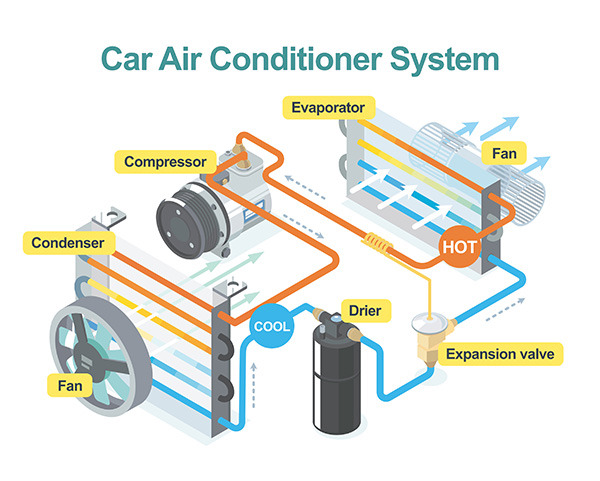
When the air conditioning blows cold on the road but turns warm at stoplights, the system is usually losing the airflow it needs to release heat. Vehicle speed pushes outside air through the A/C condenser. Once the car stops, electric cooling fans must take over that job.
A weak fan, electrical fault, blocked condenser, or refrigerant problem can make cooling fade at idle and return as soon as the vehicle begins moving. The pattern is useful because it points technicians toward components that behave differently at low speed.
How Condenser Airflow Controls A/C Temperature
The A/C system removes heat from the cabin and releases it through the condenser, which is mounted near the front of the vehicle. Refrigerant enters the condenser as a hot, high-pressure vapor. Air passing through the condenser removes heat and allows the refrigerant to change into a high-pressure liquid.
At highway speed, forward movement creates strong airflow through the grille. At a stoplight, that natural airflow disappears. The cooling fan must pull or push air through the condenser and radiator. If airflow falls too low, refrigerant pressure rises, and vent temperature becomes warmer.
A Weak Or Failed Cooling Fan Is The Most Common Cause
Many vehicles use one or two electric fans controlled by relays, modules, sensors, and the engine computer. The fans may operate at several speeds depending on refrigerant pressure, engine temperature, and A/C demand.
A fan can fail completely, run too slowly, or lose one operating speed. In each case, the A/C may cool normally while the car is moving because road speed compensates for the missing fan airflow. Cooling then drops at idle because the condenser can no longer release heat effectively.
Common fan-related faults include:
- Worn fan motor
- Failed relay or fuse
- Damaged fan control module
- Corroded connector
- Broken wiring
- Faulty pressure sensor
- Incorrect computer command
- Physical damage to the fan blade
A technician can verify fan command, power, ground, current draw, and operating speed. Replacing refrigerant will not correct a fan circuit that is failing to move enough air.
Condenser Blockage Can Create The Same Symptom
Even when the cooling fans operate, air must pass through the condenser fins. Dirt, leaves, plastic bags, insects, and road debris can block the front surface. Bent fins can also restrict airflow across part of the condenser.
Debris may become trapped between the condenser and radiator, where it is difficult to see from above. The A/C then performs better at speed because increased airflow forces more air through the restricted area. At idle, fan airflow may not be strong enough to overcome the blockage.
An inspection should include the entire condenser surface, the space between the heat exchangers, and any active grille shutters fitted to the vehicle. Cleaning must be performed carefully because high-pressure water can bend delicate fins and further reduce airflow.
Low Refrigerant Can Reduce Idle Cooling
Low refrigerant often causes weak cooling under several driving conditions, but the problem may become more noticeable at idle. Compressor speed is lower when the engine is idling, and a low charge may prevent the evaporator from receiving enough refrigerant to maintain cold vent temperatures.
Automotive A/C systems are sealed. Refrigerant does not get used up during normal operation. If the charge is low, a leak is present somewhere in the compressor, condenser, evaporator, hoses, seals, fittings, or service ports.
The correct approach is to recover and measure the refrigerant, locate the leak, repair the failed area, evacuate the system, and recharge it by weight. Adding refrigerant without measuring the existing charge can overfill the system and create high pressure, poor cooling, or compressor strain.
The Compressor May Be Weak At Low Speed
The compressor circulates refrigerant and creates the pressure difference needed for cooling. A worn compressor may produce acceptable pressure at higher engine speed but struggle at idle. Some variable-displacement compressors also use electronic control valves that can stick or respond incorrectly.
Compressor trouble may cause warm air at stoplights, slow cooling after startup, unusual noise, or pressure readings that do not respond correctly as engine speed changes. Diagnostic testing includes comparing high-side and low-side pressure, vent temperature, compressor command, and refrigerant flow at idle and at increased rpm.
A weak compressor should be confirmed through testing before replacement. Fan failure, low charge, sensor faults, and condenser restriction can all produce similar pressure patterns.
Engine Temperature Can Affect A/C Operation
The engine and A/C system share airflow through the front of the vehicle. If the engine begins running too hot at idle, the computer may reduce or disable compressor operation to protect the engine. A failed cooling fan can therefore cause both warm A/C air and rising coolant temperature.
Watch the temperature gauge when the A/C warms at a stop. A gauge that climbs in traffic and returns toward normal while driving strongly points toward a fan, airflow, radiator, thermostat, or coolant circulation concern.
Do not continue driving if the engine temperature rises above its normal range. Overheating can damage cylinder heads, gaskets, pistons, and other internal components. Regular maintenance should include checking the coolant level, fan operation, and the visible condition of the cooling system.
What Technicians Check To Find The Cause
The testing process should reproduce the symptom at idle and while the vehicle is moving or operating at increased engine speed. The technician checks vent temperature, refrigerant pressure, fan operation, compressor command, condenser airflow, and engine temperature.
Electrical testing may be needed to verify relays, fuses, wiring, sensors, and control modules. If the refrigerant charge is low, leak detection follows before the system is recharged. Testing the full system prevents an unnecessary recharge or compressor replacement when the real fault is inadequate airflow.
Get Car A/C Repair In Burbank, CA, With Future Auto Service
Future Auto Service in Burbank, CA, can test cooling fan operation, condenser airflow, refrigerant pressure, compressor performance, and electrical controls when your A/C turns warm at stoplights.
Contact us to schedule car A/C service and correct the problem before rising pressure or engine temperature damages other components.